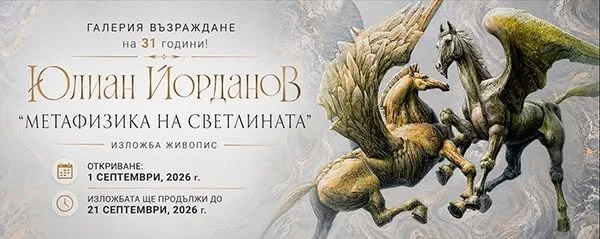
Yulian Yordanov - Metaphysics of the Light - Gallery Vazrazdane - Plovdiv Bulgaria 2026
Julian Yordanov - the Passionless Dramatism of an Ardent Soul
Lovech - an interesting phenomenon. Several of the most powerful, fantastic, surrealistic, and figurative artists of our time: Teophan Sokerov, JulianYordanov, Eduard Penkov, and so on, were born there. What kind of genetics and other accumulations has this small Balkan town, which for us is mainly related to the name of Vasil Levski.
Julian is undoubtedly the most talented, most brilliant, most passionate, and most award-winning graphic artist today. I have seen hundreds of spectators in front of his works and their reactions of amazement and wonder. The mystery of creativity is sometimes a pure enigma - you can say hundreds of superlatives and still say nothing. And Julian is a complex amalgam of opposite feelings and passions; he is a very restless and fiery soul which finds it hard to get a pier. At the core of his creative ego is the dramatism, both sensual and thoughtful, that unites all other components of the creativity. Drama, which determines the puzzle of the compositions, which builds the wings of fantasy, that moves the underwater currents in the painting, entangles and unravels the actions of the subjects, and stirs the times as in a magic pot. This dramatism seems to act and originates from several sources.
There is a drama of action. Main symbolic characters are Time and Space. Julian loves to play with the times, to surprise the viewer with their transience and eternity. He reveals the historical, moral and aesthetic categories and meanings of Time. Dreams and mirages, past and future, apocalyptic creatures and characters, love tragedy and sensual illusions - everything merges into a powerful movement of human passions, of human spirit to the infinite and unachievable. The rich creative imagination, associative thinking, and the author's good culture help him to reflect the being in Time, borrowing from different cultural, factual, mythological, and ethnic strata.
Time dramatically builds up and destroys the author's poetic libraries and temples, examines and spreads the life chronicles and records. The spatial reflections of Time are filled with the tragedy of destruction, the pain of separation, and the passions of experience and lost. Flying ships look like skeletons, ruining towers at the moment of their rise - here the destructive drama of the spaces in Time reigns. The tragedy of the Icarus collapsing, the drama of the unfulfilled life destiny, and the illusion of the Meaning. In the spaces of Time the complex story lines of human and animal bodies mingle and wander, and dramatically seek and assert their right to life, freedom and existence. And a supreme work - the ex libris "Descending from Cross" (1999), where Jesus falls into the hands raised to take him, and the cross articulated by countless human suffering bodies, stands unmatched in the space of time.
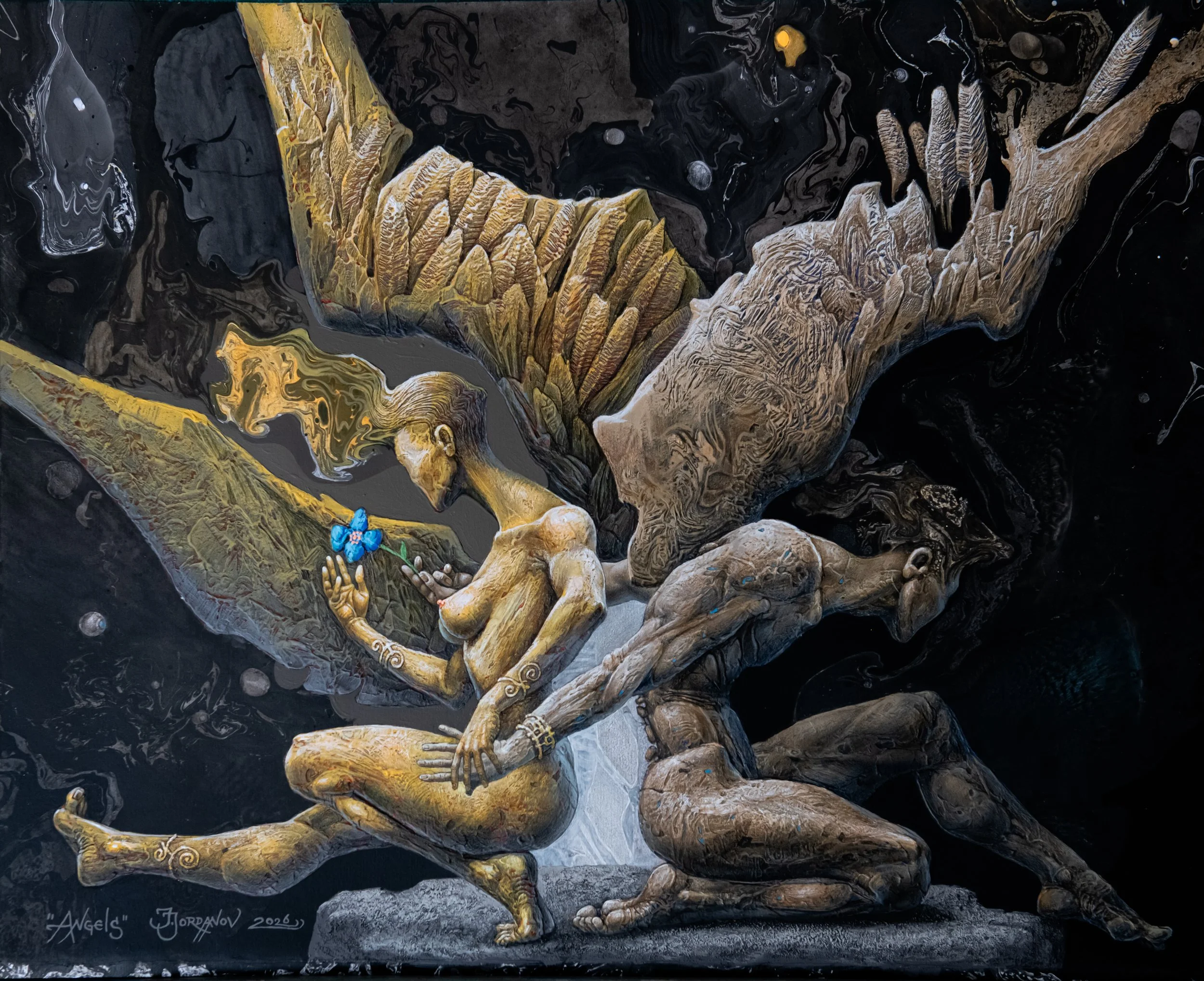
And here we come to the individual's drama of the situation. The author is interested in the tragedy of human existence, chooses his characters from the literature and myths, from the antiquity to the toreador and... the tree. Julian unravels, and creates a dramaturgy of drama. An exceptional painter of the human body, the author transforms it hundreds of times, deforms it according to his own sense of drama, collates, joins, and divides the human couple into frantic relationships, always on the brink of dramatic trials, passionate longings for unachievable love. His men always seem to be in peak moments, at the tip of the needle and the frenzy, which only the collapse follows. The craving for each other is so irresistibly strong, as if the bodies start to break apart. The desire is stronger than the eventual occurrence. It is the dramatic skeleton of passion, and love as if cannot bear its fiery element. It is no accident that in a new series of drawings, the bodies are painted tragically disunited, devoid of the possibility of merging. There are wings and many touches, but everything is in vain...
Julian's characters are all images burned in the drama of their existence. The dancing Salome, in whose shadow is embedded the cut head of John the Baptist. The lonely Hamlet, tragically torn in his inability to choose. Moses who will not enter the Promised Land. The dramatic power of Hercules in his exploits, which brings him only grief. The toreador and bull fatally entangled in each other. Minotaur devastatingly encoded in the multifaceted loneliness of the Labyrinth. Another Icarus in the tragic fall from the highest and coveted.
European master of the ex libris Julian embodied more static and philosophical stories, which, on a deeper level, carry the messages of a cool but not less influential drama. Like the lost cause - to stand on the chess board against Death. Or to live your days in dolce far niente, blind to everything outside you. Ex libris is a complex genre. To put up into shape the quintessence of the human personality, to focus the idea of a motive in a graphic frame, to reconsider the moral, vice, history, myth, love, and in a purely visual way to find the most exact accent around which to build that, the only possible storyline - there Julian is in his element. And something very important: he is always looking for depth, and there usually drama and tragic are.
Julian's erotic works are also restless. They often gravitate around the lust, which is a sensual element and as such it is not far from the dramatic. In "Erotic Arena" (2001), the naked woman is whipped. In "The Temptation" (2001), the female bodies are dramatically and frankly exposed.
Vladimir Genadiev writes: "The erotic hints, the complex postures of the tempting female bodies, at first sight, seem to be ostentatious, but they are the result of great creative demand and opportunities at the moment of drawing."
Yes! Julian seeks to create his ideal in the works, his model for the perfect woman. These are the dramatic quests of a man. In ordinary life, it is difficult to find, to achieve the dream, but in one creation the brilliantly gifted author sublimates his dream and will share it with the viewer.
Another component in Julian's works carries drama, or at the very least it builds the dramatic nuances and shades in compositions. These are the precisely found and worked out details, "accomplished and printed with mastery, put into a fictional reality" - according to Vladimir Genadiev again.
The details refine the whole composition in the works. Starting from the clouds, sea waves, plants, rises, towers, buildings, to the smallest body muscle - everything is functionally and mathematically implicated in the emotional network of the compositional structure. The plasticity of the exact image is amazingly alive and still ultimately subordinate to the author's fantasy, his futuristic messages, and dramatic nuances that act on the viewer almost subconsciously and intuitively.
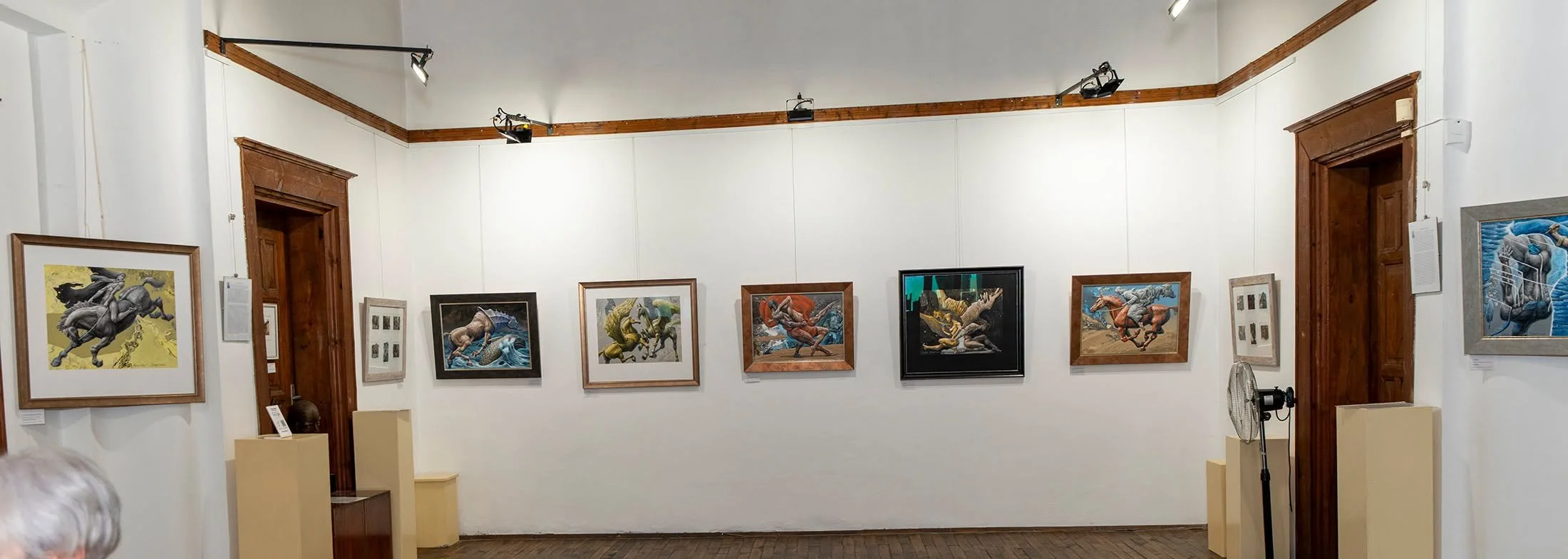
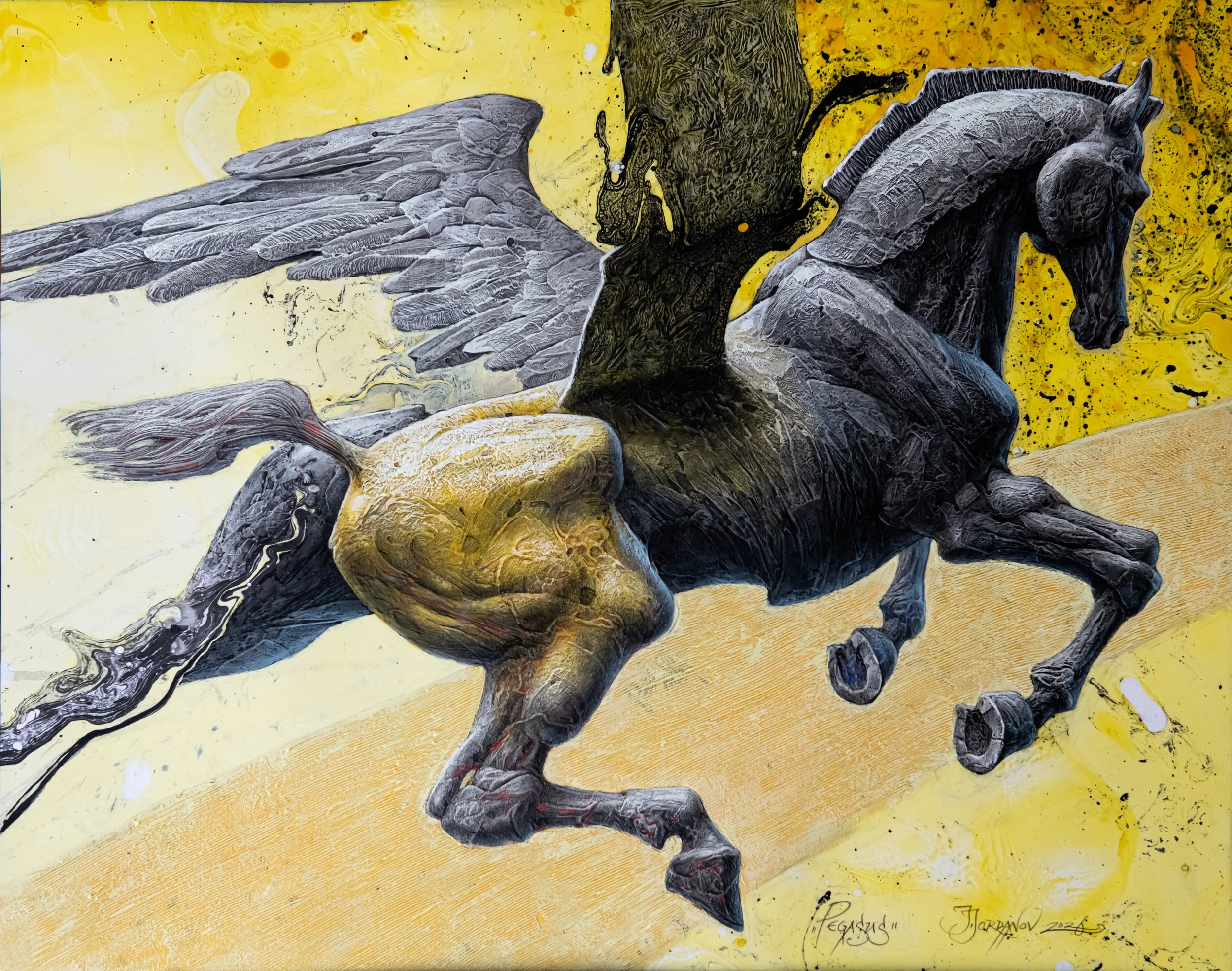
And what kind of dedication to Julian's horse has in his works! The horse is almost present in every second work, and it is also largely dramatic. It is always close to man, and still is a single entity. Trapped in the dramatic procession of bodies in "The New Age" (2006), to the marked Pegasus - with his wings; the horse is the second main character after man. Even riding by him, it has convincingly free will. The author often chooses it and as a historical bearer - "Artefact III" (2005). The horse is deeply empathetic to the human dramaturgy. Pegasus has wrecked wings, just like the wings of the falling Icarus, but sometimes it carries on these wings the entire library of human thought and feelings - the "Poetic Library" (2002). The horse is an escape opportunity for a tragically failed human couple. And at one extreme moment the horse merges with the man to appear the centaur, the bearer of wisdom, light and knowledge. Julian returns the Greek myth in our time to convince us that some things do not change - "Enlightener" (2015).
In the past few years, the artist has increasingly turned to the drawing, and more recently to the painting with acrylic. On the eve of his 50th anniversary, perhaps, there has been a visual and other fatigue from the graphic works, from the cruel and often painful path of engraving.
His acrylic paintings also mark a certain change in Julian's author's style - less details, consolidation of form, a new plasticity, and even prominent monumentality. This new form brings new dramaturgy; it is a new force of the dramatic. Simple compositions with large, gripping in their dramatic proportions figures, which act as an electric shock - instant, powerful and stunning. Such are "Duel" (2015), "Pegasus" (2015), "Guardian" (2015). There is a clear and pronounced "tearing" of the figures. There is no memory of the previous filigree sophisticated bodies. The anguish of spirit and soul has also spectacularly reflected the body. The disintegration and incompleteness of figurativeness creates a powerful drama in the compositions and characters' actions are in the tragic nuance of strong and fateful passions. Even the trees are carriers of drama and conflicts. The works elicit anxiety, doom, and special disobedience.
Very few graphic artists manage to move from the graphic art to painting successfully and seamlessly. Obviously, the brilliant Julian Yordanov, a successor to Alvin Brunovski, who is already a myth, will do this: without abandoning the graphic art, to transfer some of his amazing talent and ability to the painting. He will select new tools and forms to reveal the passion of his blazing soul into new courses of his dramatic artistry. That is why it is his real life, his mission of an author, his happiness of a creator. The painting! - there he will free his thought; he will release his soul from the angels and the demons.
The rest is just Being.
Krasi Aleksieva, 2016